There is a persistent gap between how companies think they are spending on corporate travel and how they are actually spending on it. The gap exists not because finance teams are careless, but because the data that would close it is scattered across systems that were never designed to talk to each other. A booking tool here, a corporate card platform there, an expense report system managed by yet another third-party vendor and sitting somewhere in between, the actual record of what happened on any given trip, fragmented and difficult to reconcile.
Cerebri AI, based in Austin, Texas, was built to close that gap. The company has spent years developing AI-powered agents and applications specifically designed for the travel and expense category and its latest moves suggest it is accelerating toward becoming the definitive intelligence platform for corporate travel management worldwide.
The Scale of the Problem
To understand why Cerebri AI’s work matters, it helps to appreciate the scale of the category it operates in. Global business travel spending in 2026 is projected to exceed $1.5 trillion making it one of the largest single discretionary spending categories in the corporate world. And yet, despite that scale, most companies have remarkably limited visibility into whether that money is being spent well.
Policy compliance rates are often lower than travel managers believe. Savings opportunities that should be captured through preferred vendor agreements regularly slip through because the data connecting a traveler’s booking to the relevant corporate rate isn’t accessible in real time. Expense reports are processed weeks after the fact, long after the opportunity to course-correct has passed.
These are not edge cases. They are the normal state of affairs for most organizations managing corporate travel at scale, and they exist because the underlying data infrastructure was never built to support real-time intelligence.
What Cerebri AI Actually Builds
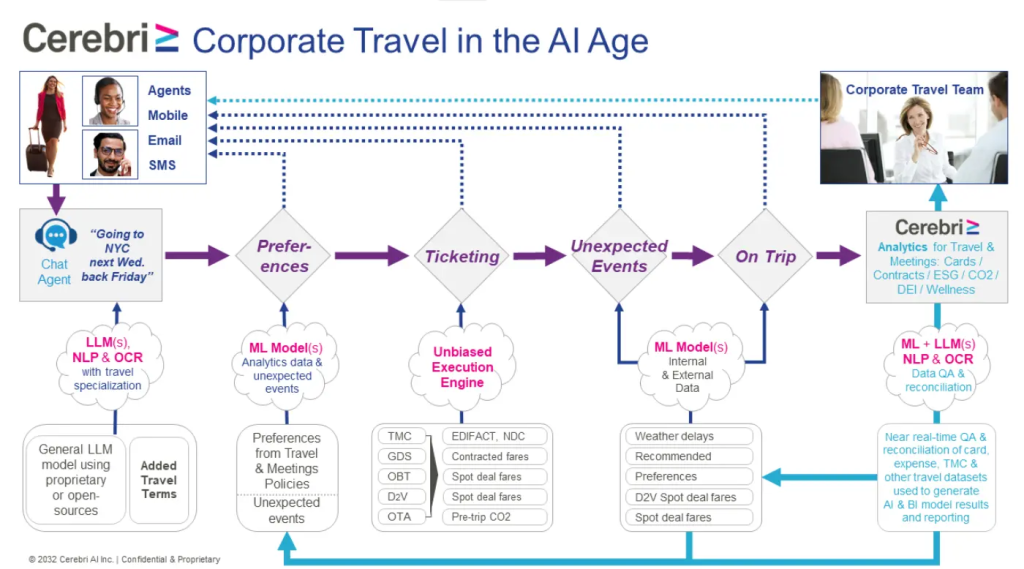
The core of Cerebri AI’s platform is its AIQ data engineering system a proprietary infrastructure that pulls travel and expense data from multiple disconnected sources, cleans and reconciles it, eliminates duplicates, and aggregates it into what the company describes as an accurate record of every dollar spent by every employee, every day.
That record becomes the foundation for everything else the platform does. AI agents can be trained against it to flag anomalies, identify savings opportunities, enforce policy in real time, and surface insights that would be invisible in any single-system view. Enterprise travel and expense analytics that used to require a dedicated analyst team and a two-week reporting cycle can be generated automatically and continuously.
The company develops and sells these capabilities as AIQ Agents and Applications modular tools that travel, procurement, and finance teams can deploy to address specific operational problems, from reimbursement processing to indirect procurement optimization.
Strategic Expansion Through Acquisition
Earlier this year, Cerebri AI completed the acquisition of InterplX Inc., a Minneapolis-based company with more than 30 years of history in employee expense processing and reimbursement. InterplX had recently expanded into the guest travel and expense market a category that requires different data handling than standard corporate travel programs for security and compliance reasons.
The acquisition is strategically significant because it extends Cerebri AI’s coverage into a part of the expense landscape that had previously been outside its scope. Guest travel covering contractors, interview candidates, board members, and other non-employees represents a meaningful slice of total organizational travel spend that is often even less visible and less controlled than employee travel. Adding that capability rounds out a platform that can now claim genuinely comprehensive coverage.
Jean Belanger, Co-founder and CEO of Cerebri AI, has noted that the company has been planning this expansion for the better part of two years signaling that the acquisition was a deliberate strategic step rather than an opportunistic one.
The Agentic Future of Travel Management
The broader shift toward agentic AI systems that don’t just analyze but act is particularly relevant to the travel and expense category. The most advanced vision for what Cerebri AI is building is not a dashboard that shows travel managers what happened last quarter. It is a set of intelligent agents that continuously monitor spending, surface opportunities, take automated corrective actions where authorized, and learn from outcomes over time.
This vision is beginning to take shape in the company’s partnerships and platform integrations. A collaboration with BizTrip.AI, an agentic AI platform for business travelers, gave that system access to Cerebri AI’s rich corporate travel datasets enabling personalized, policy-compliant booking recommendations that improve over time as the agent learns each traveler’s preferences and patterns.
For finance and procurement leaders who have spent years managing travel spending with inadequate tools, Cerebri AI represents a fundamentally different approach one built on the premise that real intelligence requires clean, unified data, and that clean data is something you have to build, not something you can assume.
References:
- Business Wire – BizTrip.AI and Cerebri AI Collaboration, August 26, 2025
- CB Insights – Cerebri AI Company Profile and Platform Overview, 2026
- PitchBook – Cerebri AI 2026 Investor Profile
- Morningstar – BizTrip.AI Cerebri AI Partnership News, 2025
- TechIntelPro – Agentic AI for Corporate Travel Analysis, 2025