There’s a moment in every technological company’s growth journey where speed alone stops being the competitive advantage. At a certain stage, the ability to build efficiently to coordinate teams, eliminate redundancy, and convert engineering effort directly into product becomes more important than simply hiring more people and moving faster. For Arrive AI, that inflection point appears to have arrived, and the company is responding with a deliberate and strategic realignment of its entire engineering organization.
The Indianapolis-based company, which trades on the NASDAQ under the ticker ARAI, announced this week that it has completed a comprehensive restructuring of how its engineering teams are organized and how they work. The move is designed to accomplish three things simultaneously: accelerate the pace of product development, reduce the company’s reliance on expensive third-party contractors, and lay the operational groundwork for the commercial deployments it has been building toward for the past several quarters.
What Arrive AI Actually Does
Before understanding why this restructuring matters, it helps to understand what Arrive AI is building in the first place. This is not a company making chatbots or enterprise software. Arrive AI is focused on the physical world specifically, on building the infrastructure that makes autonomous delivery possible on a scale.
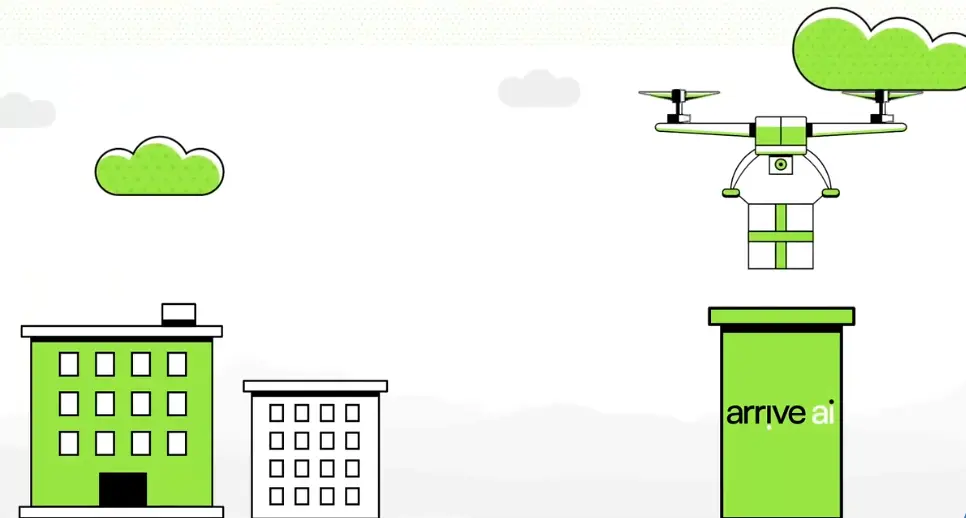
The company designs and deploys what it calls intelligent delivery endpoints the smart, connected physical infrastructure that autonomous vehicles need to complete deliveries reliably and securely. Think of it as the nervous system of a delivery network: the points where packages are transferred, verified, secured, and handed off, all without requiring a human being to manage every step of the process.
This is genuinely hard engineering. It requires software that communicates in real time with autonomous vehicles, hardware that operates reliably in real-world environments, security systems that protect packages and verify identities, and logistics intelligence that can route deliveries efficiently across a network. Getting all of those components to work together seamlessly and doing it at a cost that makes commercial deployment viable is the challenge that Arrive AI has been working to solve.
The Engineering Problem Behind the Restructuring
As Arrive AI’s team has grown significantly over the past year the company added nearly 30 professionals in the third quarter of 2025 alone, with a goal of 60 new hires across AI, software, and product engineering by year end a familiar organizational challenge began to emerge. More people, more capabilities, and more parallel workstreams can generate more output, but they can also generate more coordination overhead, more duplicated effort, and more dependency on outside resources to fill gaps between internal teams.
The strategic alignment announced this week is essentially a response to that challenge. By bringing all development efforts under a single unified structure, Arrive AI is consolidating decision-making, improving coordination between teams that were previously operating with more separation, and reducing the points of friction that slow down delivery of finished product.
The practical effects are significant. Reducing reliance on third-party development resources means the company retains more institutional knowledge internally, moves faster when priorities shift, and spends less per unit of engineering output. Streamlining the path to market means that when a feature or product is ready, the internal process for getting it deployed is shorter and less complicated.
What Leadership Is Saying
Dan O’Toole, the company’s Founder and CEO, framed the change in direct terms: aligning engineering resources is a critical step in maximizing both speed and efficiency, and this structure allows the company to move faster, deploy smarter, and better convert growing market demand into revenue.
That framing is worth paying attention to. O’Toole isn’t describing the restructuring as a response to a problem he’s describing as the next planned phase of the company’s growth following a period of deliberate team expansion. This is a company that hired aggressively, built capability, and is now organizing that capability for execution.
Why the Autonomous Logistics Race Is Heating Up
The autonomous delivery technology sector has been moving through a prolonged maturation phase. Early promises of widespread autonomous delivery within a few years were followed by a more realistic reckoning with how complicated real-world deployment is regulatory hurdles, infrastructure requirements, safety validation, consumer trust, and the sheer operational complexity of making autonomous systems work reliably outside of controlled environments.
But that maturation phase appears to be nearing its end for the leading players. Companies that have done the hard engineering work and built the necessary infrastructure are beginning to move from pilots and proofs of concept into genuine commercial operations. For Arrive AI, the engineering realignment is a direct preparation for that transition.
For investors watching the AI logistics sector, this kind of internal restructuring can be easy to dismiss as corporate housekeeping. But the companies that consistently win in hardware-adjacent technology markets are the ones that build tight, efficient engineering organizations before the market opens, not after. Arrive AI appears to be doing exactly that.
The Broader Market Context
The autonomous delivery space is attracting serious capital and serious competition. Major logistics players, automotive manufacturers, and technology platforms are all working to establish positions in a market that analysts believe will be worth hundreds of billions of dollars once autonomous delivery achieves meaningful scale. The companies that will capture the most value in that market are not necessarily the ones with the most innovative underlying technology, they’re the ones that can deploy that technology reliably, at scale, and at a cost structure that works commercially.
That is precisely what Arrive AI’s engineering reorganization is designed to support. A unified, efficient engineering organization can move a product from ready to deploy faster, can respond to field learnings more quickly, and can iterate toward the cost targets that commercial viability requires.
For anyone tracking the development of autonomous logistics infrastructure in the United States, Arrive AI’s moves this week signal that the company believes its deployment moment is approaching and that it is organizing itself to be ready when it arrives.
References:
- Indianapolis Today – Arrive AI Engineering Realignment, April 15, 2026
- JonesBoro Sun – Arrive AI Aligns Engineering Organization, April 15, 2026
- Wall St Rank – Arrive AI ARAI News Sentiment, 2026
- Finanznachrichten – Arrive AI CES 2026 Attendance, December 2025